

SCALE OF PROPORTIONS
The Ligas System’s basic principle is that the human body, whatever its physical structure, undergoes a harmonious development. Thus, it would be wrong to use the same pattern to dress two individuals with the same chest circumference but of different height (a practice still very popular with firms who sell on industrial scale, who simply modify the garment’s and sleeves’ length). It would instead be necessary to act on crucial spots in the pattern to adjust the garment’s perpendicular line.
For instance, out of two individuals who both wear size 50 clothes, one could have a broader back than the other, so the armhole depth and the center front line drop of the two garments would have to be very different. Based on these premises, the Ligas School of Cutting immediately distinguished itself thanks to its easy-to-learn scientific technical method, with an eye to the style and the main lines of made-in-Italy fashion.
By defining the Ligas System a “scientific” method, we mean to put emphasis on the methodology on which this work was based. In fact, the System’s roots are in the very accurate anthropometrical studies done by the School, through which the Ligas System contributed to change the conception of industrial size planning.
Another distinctive mark of the System was, as we said, its being easy-to-learn; considering the low level of education in post-war Italy, this wasn’t something to underestimate. To start using the method, it was merely necessary to know the simplest fractions, such as ½; ¼; 1/10.
Finally, as far as fashion and style are concerned, it is sufficient to go through the annals of the important contest for master tailors, “Forbici D’Oro” (Golden Scissors): very many of the winners are former students of the School.
Cruel Nature grants a chosen few the privilege of perfect proportions: it’s up to the tailor to use his knowledge and his art at their best, to soften and in many cases eliminate existing imperfections.
As the saying goes, “Where nature is lacking, art provides”.
Having defined the ideal human figure, we have derived from it the different scales of proportions, applicable to every single case. These scales of proportions form a guidance and crosscheck basis, which allows the tailor to work easily and surely.
Our study of the human body’s proportions in the different phases of development and of the corresponding cutting measurements is based on experience: it results from the constant and minute research done while measuring and dressing up children, youths and men of all ages.
Decades of continuous applications and experimentation on different proportions and physical structures have given us positive results, thus guaranteeing the functionality of this work.
Obviously, this study’s importance is to give a clearer artistic turn to our work: this is the reason we have ranked all the data referring to each proportion in a set of charts which we call SCALE OF PROPORTIONS.
In our case, this term indicates the ratio between height and chest measurements.
By “exact scale of proportions” we mean development proportionality, correct measurement respondence in every single part of the body and thus perfect harmony of the line, just as the header of all our charts shows.
Therefore, SCALE OF PROPORTIONS consists in the grouping of 86 charts containing the chest half proportions 30 to 70.
Out of these charts, 41 are for the working out of the jacket’s pattern, 41 are for the coat’s pattern and 4 indicate the different articles’ length measurements in relationship with the height measurement.
The charts include the following measurements: armhole depth, waist length, jacket length, back width, shoulder-to-shoulder, back neckline, waist circumference, all proportioned to height and chest.
Every chart’s header, i.e. for every chest measurement, contains the regular proportions of the human body, namely the proportions ascribed to a body developed harmoniously in respect to chest and height.
We were prompted to write these charts by the fact that our art keeps the mind so busy that often the serenity and calm needed for facts and figures are lacking.
It’s convenient and advantageous for the tailor to have precise data and previously made calculations at hand: the results are greater efficiency in his work and less waste of time and energy.
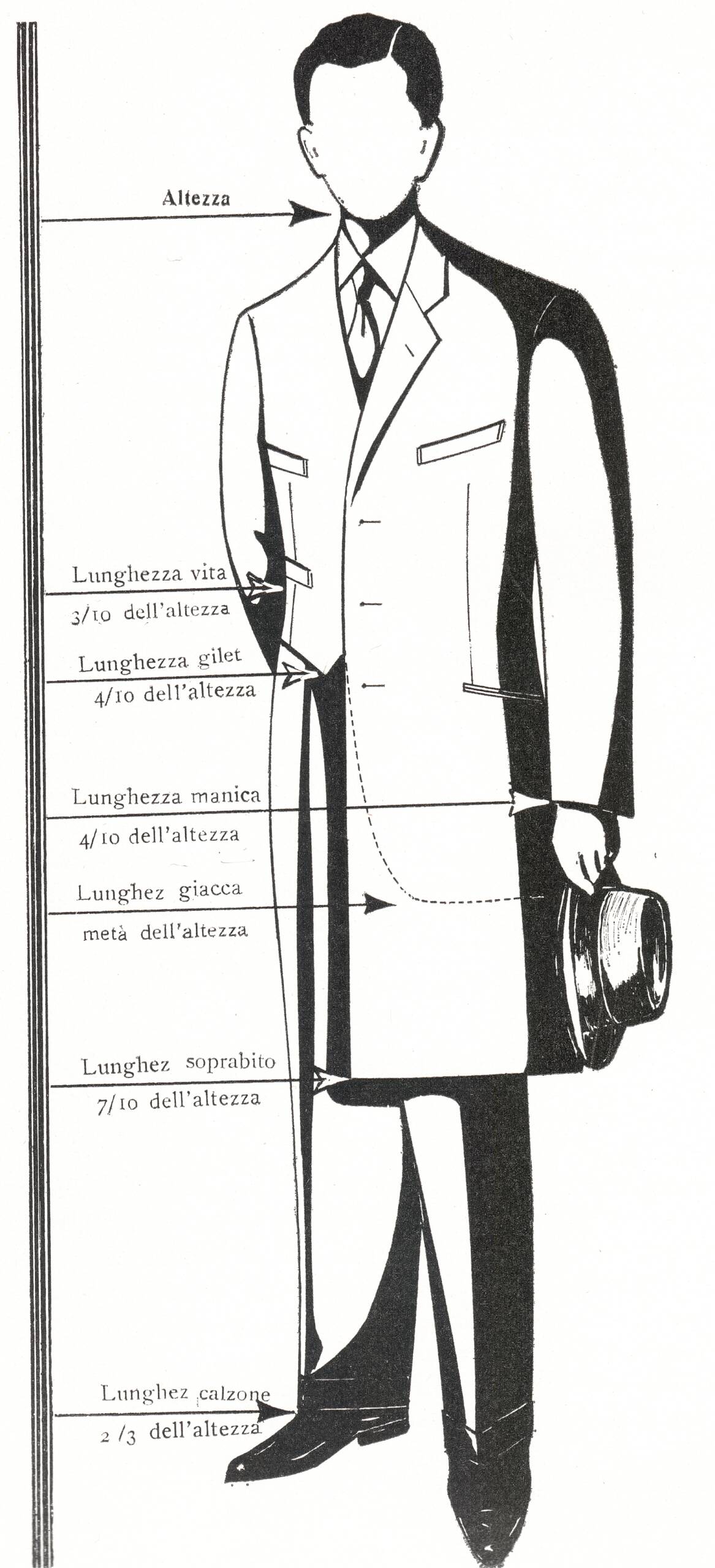
The usefulness of SCALE OF PROPORTIONS is unmistakable: it’s essential to every tailor as it is a sure guidance and crosscheck basis for a better tuning of the article.
Indeed, the measurements taken directly on the client aren’t always precise: on all occasions, it’s a good rule to crosscheck the armhole depth, back width, waist length and shoulder height measurements with the corresponding proportional measurements.
Particularly, the back width measurement must always be adjusted and compared to the proportional measurement.
Consequently, when cutting a garment, it’s sufficient to take SCALE OF PROPORTIONS at a given chest measurement to quickly find, with no possible errors, all the proportional data needed for the control and working out of the pattern.
From what we have stated, it’s obvious that we cannot consider good tailors, much less responsible teachers, those who don’t reckon with the proportions-principle for the sake of “pure realism”.
Even if direct and triangular measurements and mechanical means hypothetically turned out to be practical in their application and faithfully reproduced an individual’s anatomical traits on a plane, they would be worthless without the fundamental evaluation-of-proportions factor.
The mere production of close-fitting garments is insufficient to show the degree of ability and artistic flair of a tailor: as we have said, ours is an art, consisting of the ability to adjust, model and make pleasing to the eye the human figure, after whatever fashion and style.